D&D 5e guide
Your first character in 10 minutes
A complete, real example: a level 1 cleric made with the Character Forge, with every choice explained, all the way to the printed sheet.
The plan
We are going to make a level 1 character for the 2024 rules with the Character Forge, on a phone or a computer, with no account and nothing to install. What you see in the screenshots is what really came out: a human cleric called Halwen Ashford. If you follow the same steps your character will have other rolls and another name, but the decisions will be the same.
- Rules: 2024 or 2014 (30 seconds).
- Class (2 minutes).
- Species and background (2 minutes).
- Ability order, alignment and purse (1 minute).
- Forge and read the sheet (2 minutes).
- Change what you don't like with Edit (1 minute).
- Choose the PDF and the spell cards, and print (1 minute).
Before you start, ask your Dungeon Master (DM) two things: which rules the table uses, and how ability scores are made (rolling dice, the standard array or point buy). With those answers you won't have to redo anything.
Step 1: the rules
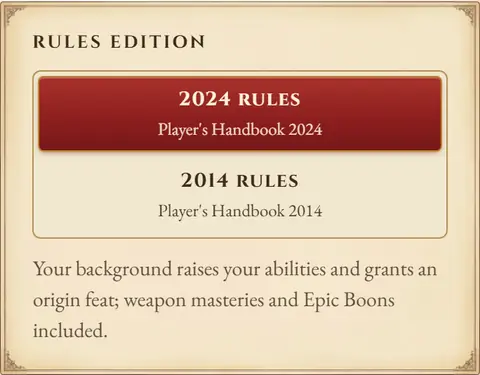
At the very top you choose between "2024 rules" and "2014 rules". Both are fifth edition, but quite a few details change: in 2024 your background raises three ability scores and gives you an origin feat, classes have weapon mastery and spells are prepared differently. If your table uses the new Player's Handbook, or doesn't know, leave 2024. Everything else in the Forge (classes, species, backgrounds, spells) follows this button.
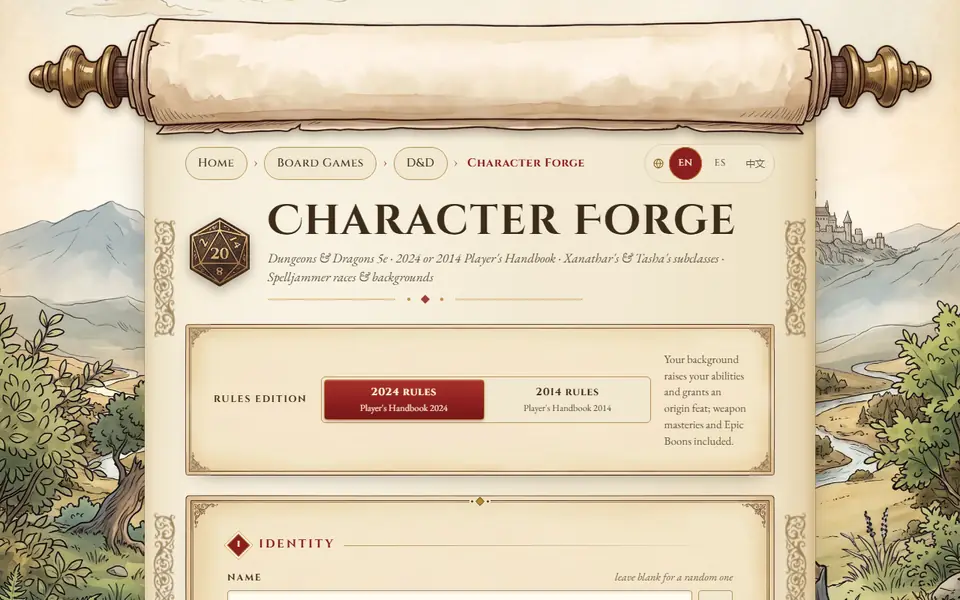
On the identity card you can type a name or leave it blank: if it is empty, the Forge picks one that suits your species. Level stays at 1, which is where almost every campaign begins.
Step 2: the class
We chose Cleric for three reasons that also work for you if you are unsure: it is useful in every fight, it wears decent armor and its magic (healing, blessing, attacking with light) makes sense as you read it. If you would rather play something else, our guide how to choose a class covers all thirteen with an example each.
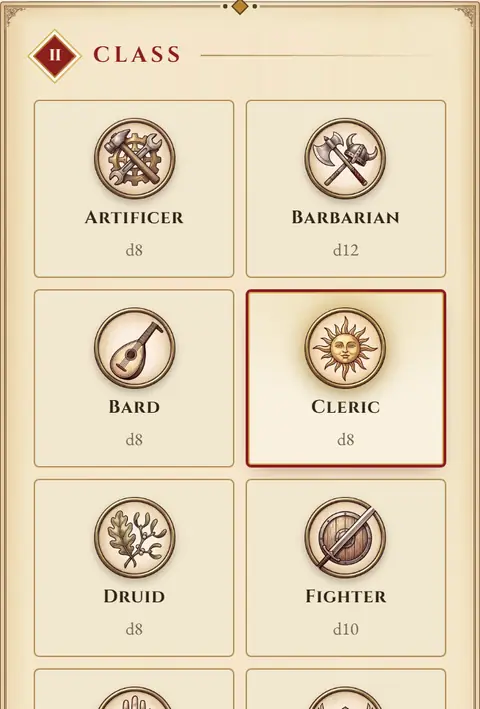
Below it is the subclass, with the note "Unlocks at level 3". In the 2024 rules every class picks its subclass at level 3, so at level 1 you don't have to worry about it.
Step 3: species and background
Your species (what used to be called race) gives fixed traits: darkvision, resistances, a cantrip. Your background says what you did before you became an adventurer and, in 2024, it is what raises your ability scores.
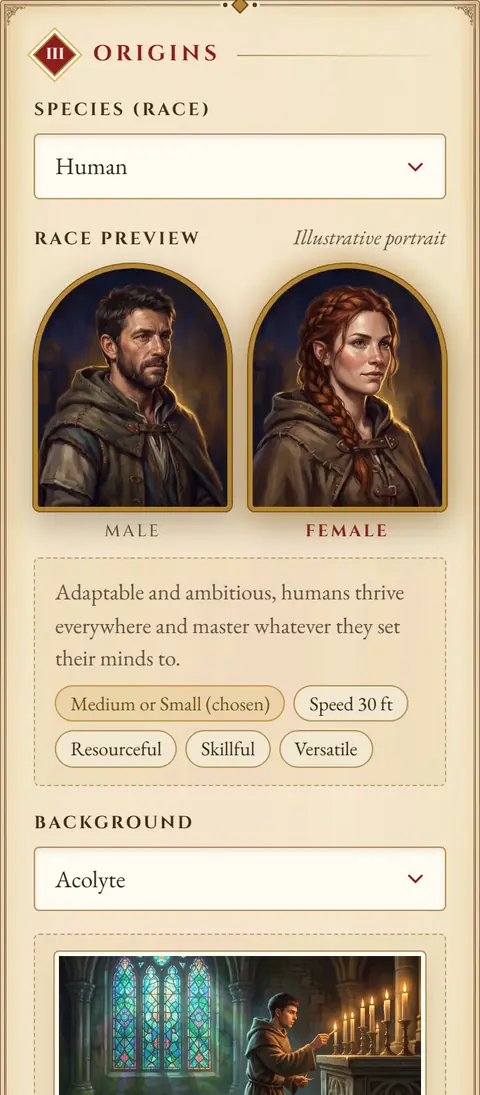
For Halwen we picked Human and Acolyte:
- Human looks like the boring choice and is one of the most useful for a beginner: Versatile gives you a second origin feat, Skillful one more skill and Resourceful Heroic Inspiration every time you finish a Long Rest, in other words one reroll a day.
- Acolyte raises Intelligence, Wisdom or Charisma (Wisdom is the cleric's spellcasting ability), gives proficiency in Insight and Religion and the cleric Magic Initiate feat: two more cantrips and a level 1 spell you can cast free once a day.
The rule of thumb: look for a background that includes your class's main ability. For a fighter, Soldier or Farmer; for a wizard, Sage; for a rogue, Criminal.
Step 4: abilities, alignment and purse
The Forge doesn't ask you for numbers: it asks for an order. It rolls 4d6 six times, drops the lowest die of each roll and puts the best totals at the top of your list. When you pick Cleric, the order switches to the recommended one (Wisdom, Constitution, Strength, Dexterity, Charisma, Intelligence). You can drag to change it; the "Use Cleric order" button takes you back to the recommendation.
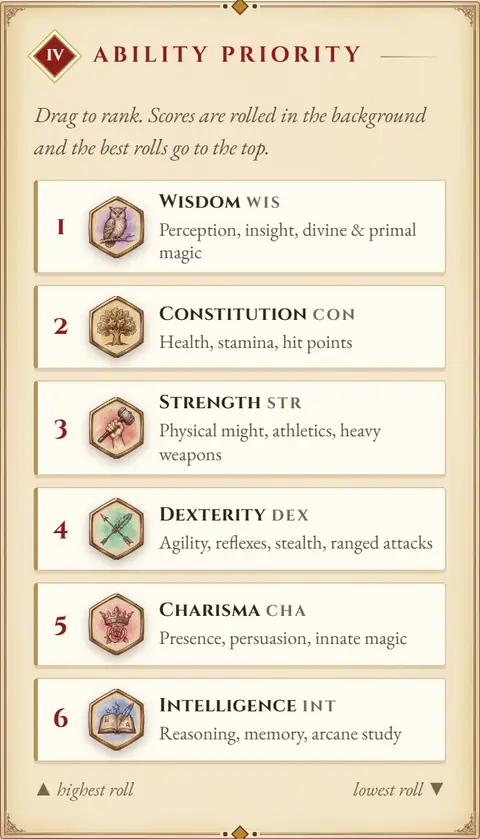
Why is Constitution second? Because it adds to your hit points and to the saves that keep you concentrating on a spell. And Strength third on a spellcaster? Because the 2024 cleric can wear heavy armor with the Protector Divine Order, and some armor asks for Strength.
Alignment is a personality hint, not a rule: we chose Neutral Good. We left the purse at zero, because the Forge already adds the gold from your starting gear; you would only type coins here that the DM gives you on top.
Step 5: forge and read the sheet
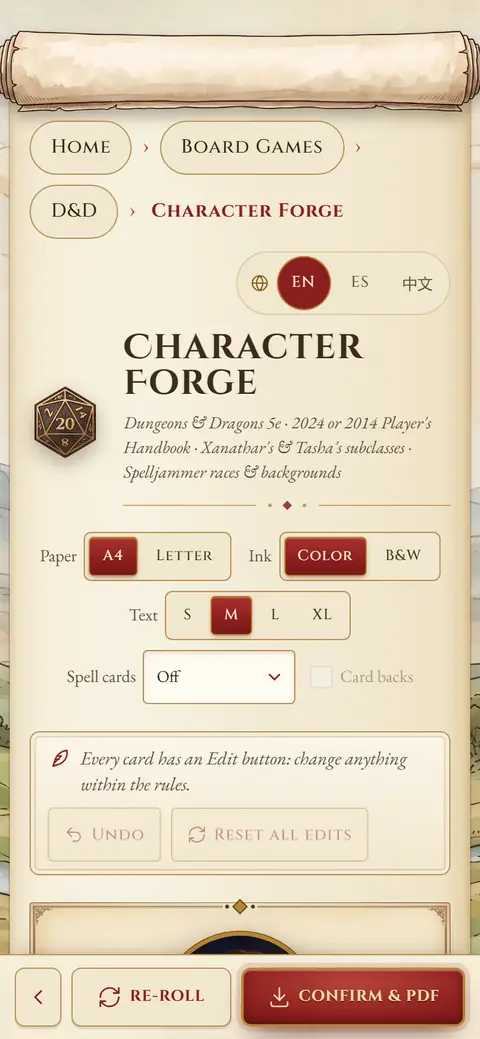
Press "Forge Character". Before the sheet appears, a window offers ways to support the site (watch an ad or donate); "See my character" takes you straight to the sheet without doing anything else. This is what came out:
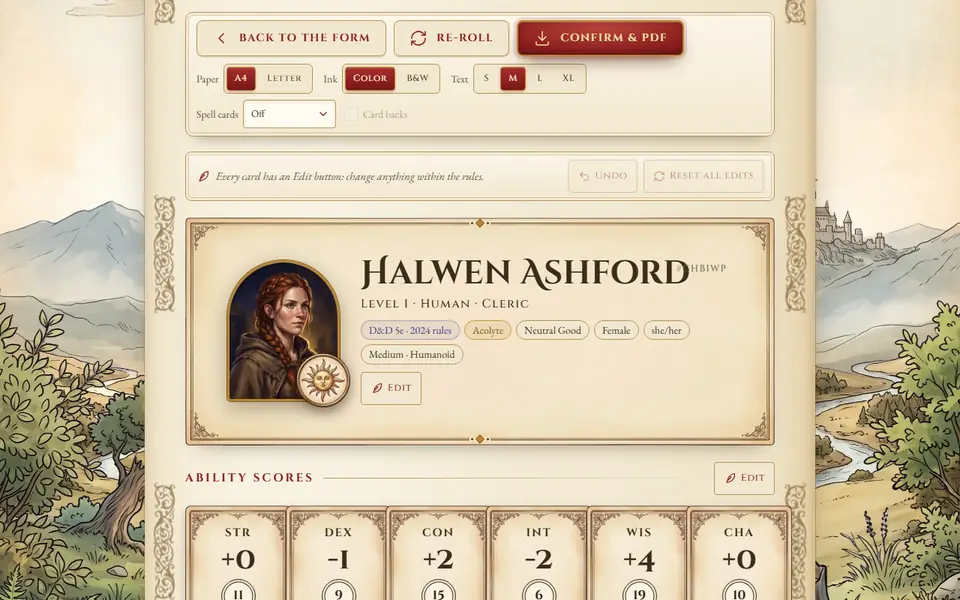
- Ability scores: Wisdom 19 (a 17 on the dice plus 2 from the background), Constitution 15, Strength 11, Charisma 10, Dexterity 9 and Intelligence 6. The card explains each number, die by die.
- Defense and health: 10 hit points (8 from the hit die plus 2 from Constitution) and AC 16 in ring mail and a shield, thanks to the Protector Divine Order the dice picked.
- Spells: save DC 14 and +6 to hit. Cantrips Sacred Flame, Guidance and Resistance; prepared Command, Cure Wounds, Guiding Bolt and Healing Word. Magic Initiate adds Light, Toll the Dead and Bless.
- Feats: Magic Initiate (from Acolyte) and Lucky (from Versatile): two luck points (as many as her proficiency bonus) to roll with Advantage.
Read the sheet from top to bottom once. You don't have to memorise it, but you should know where everything is: attacks and cantrips together, spells with their short description and equipment with its weight.
Step 6: change what you don't like
Everything the Forge decided can be changed within the rules: every card has an "Edit" button that opens only the legal options for that character, and the sheet recalculates at once. There is "Undo", "Back to the random pick" on every choice, and "Reset all edits" at the top.
Our example: imagine your DM uses the standard array (15, 14, 13, 12, 10 and 8) instead of dice. Open Edit on the ability scores, tap how they are made and choose "Standard array". The Forge places the values in your order and you can move them with the drop-downs.
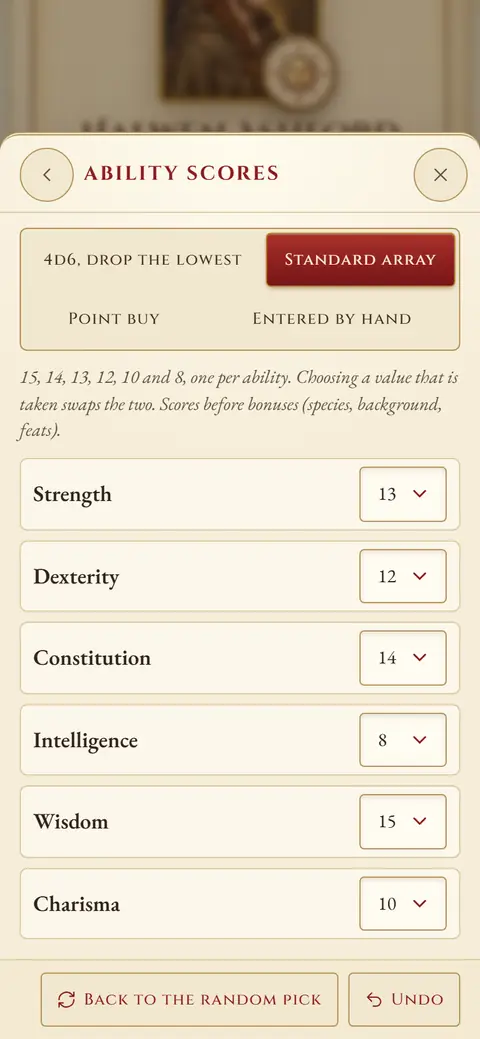
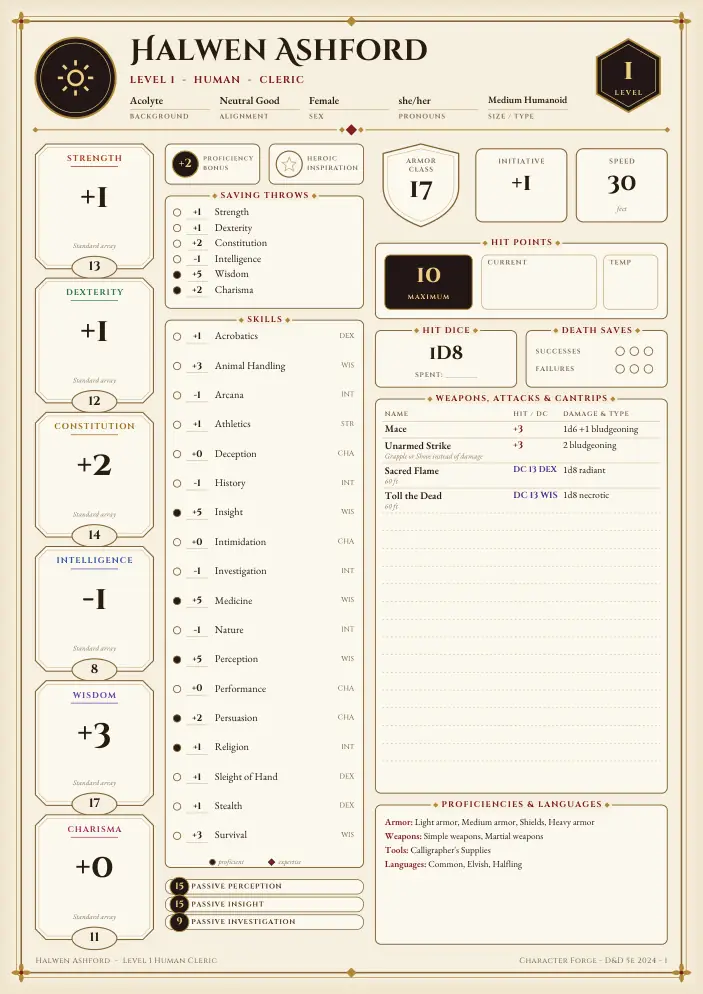
Halwen ends up with Wisdom 17, Constitution 14, Strength 13, Dexterity 12, Charisma 11 and Intelligence 8. Her spell save DC drops to 13, but Dexterity 12 lets her wear scale mail: AC goes up to 17. That is how the whole system works: you change one decision and whatever depends on it is recalculated, without you doing the maths.
Other typical changes on a first character: tap a prepared spell to send it back to the pool and tap another to prepare it, switch the Divine Order to Thaumaturge if you'd rather have a cantrip than heavy armor, or rewrite the age, looks and personality, which are only suggestions.
Step 7: the PDF and the spell cards
Above the sheet you choose paper (A4 or Letter), ink (color, or B&W, which saves ink and uses line-art pictures) and text size. The new part is the spell cards: with "My spells" the Forge adds a card for each of your character's spells, the size of a poker card, nine to a page with cut lines. "Up to my level" and "Whole class list" also print the ones you could prepare, with a star on yours.
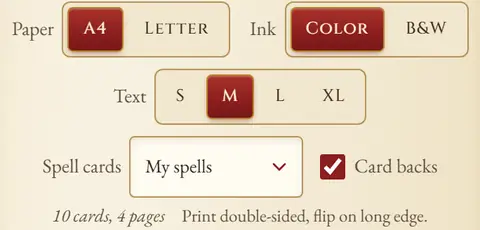
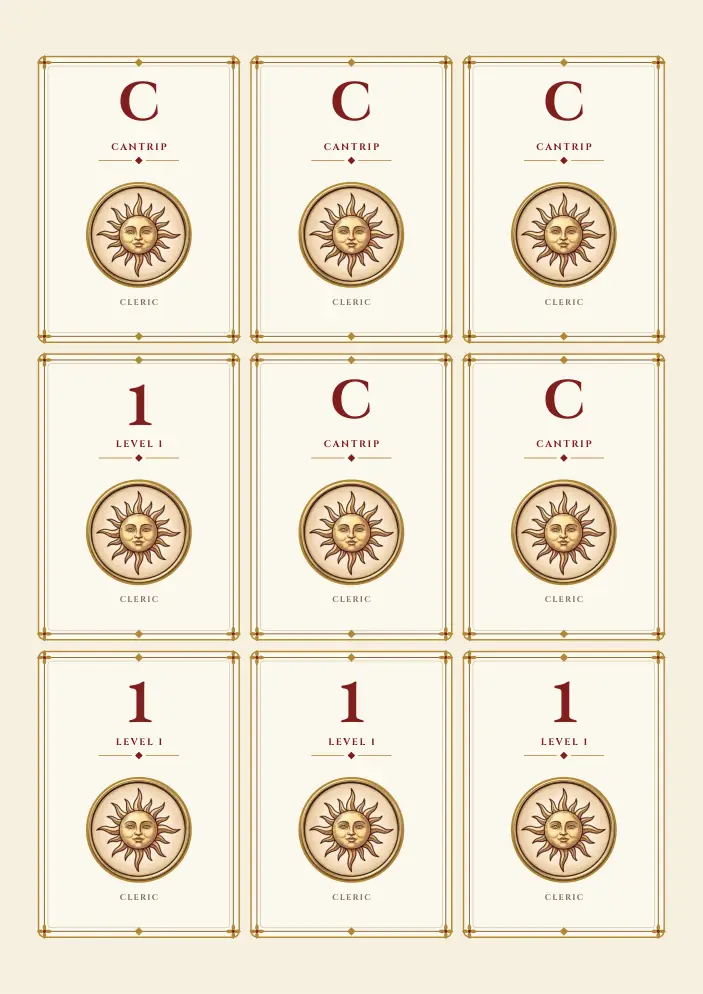
Halwen has ten cards (five cantrips and five level 1 spells). With "Card backs" ticked, each page of cards is followed by its backs, with the class emblem and the spell level: print double-sided, flipping on the long edge, and the cards come out with their backs. Press "Confirm & PDF" and you get the four-page sheet (the main page, features, spells, and equipment and story) followed by the cards.
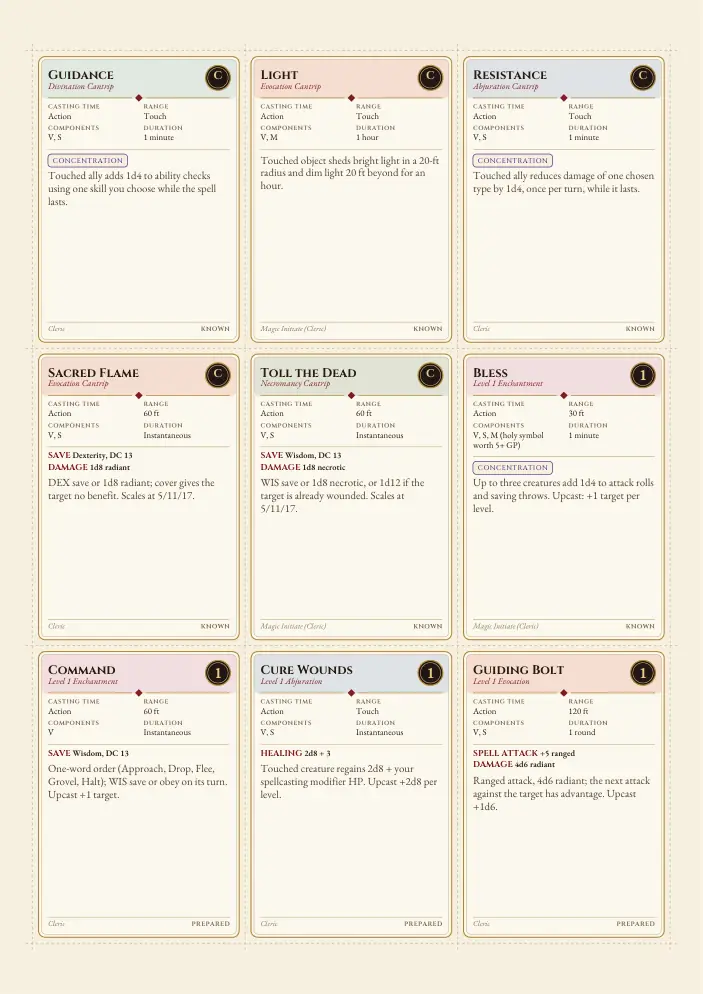
A table tip: cut out the cards of your prepared spells and lay them face up in front of you; when you spend a slot, turn a card over. It is quicker than searching the sheet, and everyone else can see what you can do.
What to bring to the first session
- The printed sheet (or the PDF on your phone) and the cut-out cards.
- Dice: a full set (d4, d6, d8, d10, d12 and d20). Halwen mostly uses the d20, the d8 (Sacred Flame, Cure Wounds), the d6 (Guiding Bolt rolls 4d6, the mace 1d6) and the d4 (Healing Word, Guidance, Bless). If you have none, any dice app will do.
- A pencil and an eraser for hit points, spell slots (two at level 1) and luck points.
- Two sentences of backstory: where you come from and why you go adventuring. For Halwen: "She served in a small temple until the priest disappeared; she is looking for answers."
- Your turn in three lines (below), so you don't freeze when it is your go.
Halwen's turn. First turn of a fight: cast Bless on three allies (Concentration). Next turns: Guiding Bolt at the most dangerous enemy, or Sacred Flame if it is behind cover. If someone drops to 0 hit points: Healing Word with the Bonus Action and, with the action, a cantrip (Sacred Flame or Toll the Dead) or the mace. You can expend only one spell slot per turn, so that turn there is no Guiding Bolt.
One last tip: tell the DM what you want to do with your character ("I want to find out what happened to my temple"). A good DM will use it, and you will feel part of the story from the very first night.
Running that first session yourself? Go on to Run a one-shot tonight.