D&D 5e guide
Run a one-shot tonight
A real adventure generated with the One-Shot Builder, prepared in half an hour and run scene by scene, with what to do when the players leave the script.
What you will have in half an hour
Your friends arrive at nine and you have nothing ready. With the One-Shot Builder you can have, in thirty minutes, a three-to-four-hour adventure with a story, scenes to read aloud, NPCs with their statistics, a balanced fight, shops with prices and maps, all in one PDF. This guide does it with a real adventure, exactly as it came out, and tells you what to fix, how to run it and what to do when the players take a path that wasn't written.
How the time splits:
- Minutes 0 to 5: generate the adventure.
- Minutes 5 to 20: read it and make four decisions.
- Minutes 20 to 30: print and set up the table.
Minutes 0 to 5: generate the adventure
The form asks for six things. These were our answers, and why:
- Rules: 2024. They decide the stat blocks, the encounter budgets and the prices.
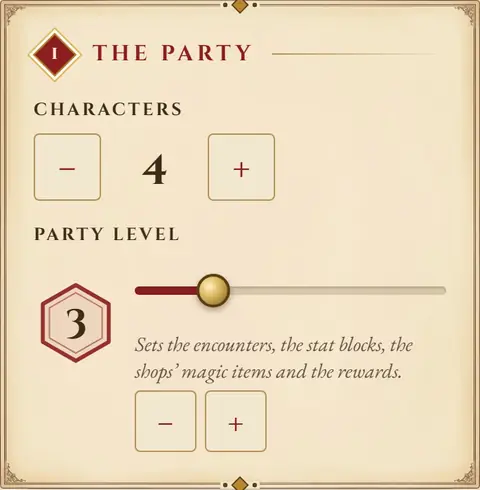
- The party: 4 characters of level 3. Enter the real number of players coming tonight; the builder fits the fights to that group.
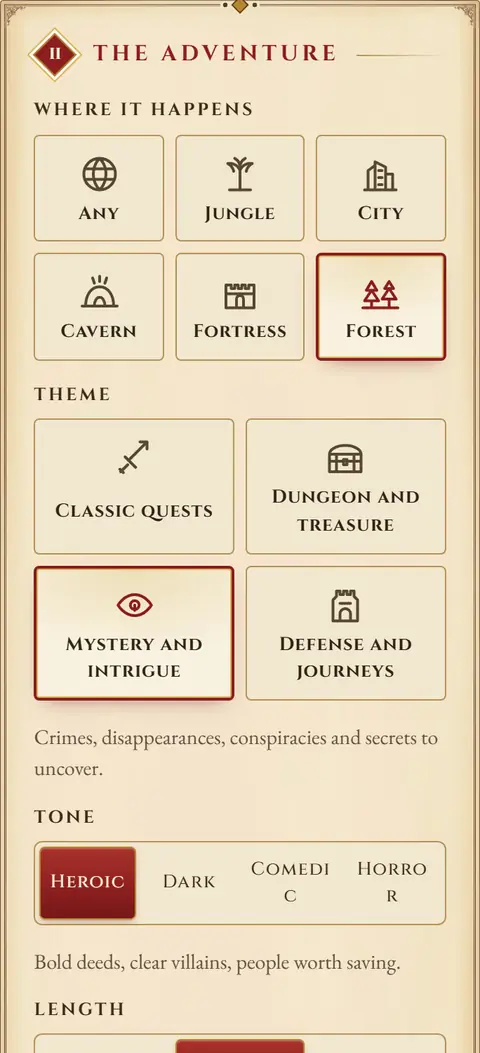
- Where it happens: Forest. Pick a place your players can picture without explanations.
- Theme: Mystery and intrigue. It brings social scenes and clues; if your group would rather fight, "Dungeon and treasure" has more combat.
- Tone: Heroic. It changes the read-aloud text and the moral rewards.
- Length: Standard (3 to 4 hours, 4 or 5 scenes). For a weeknight, Short (about 2 hours, 3 scenes).
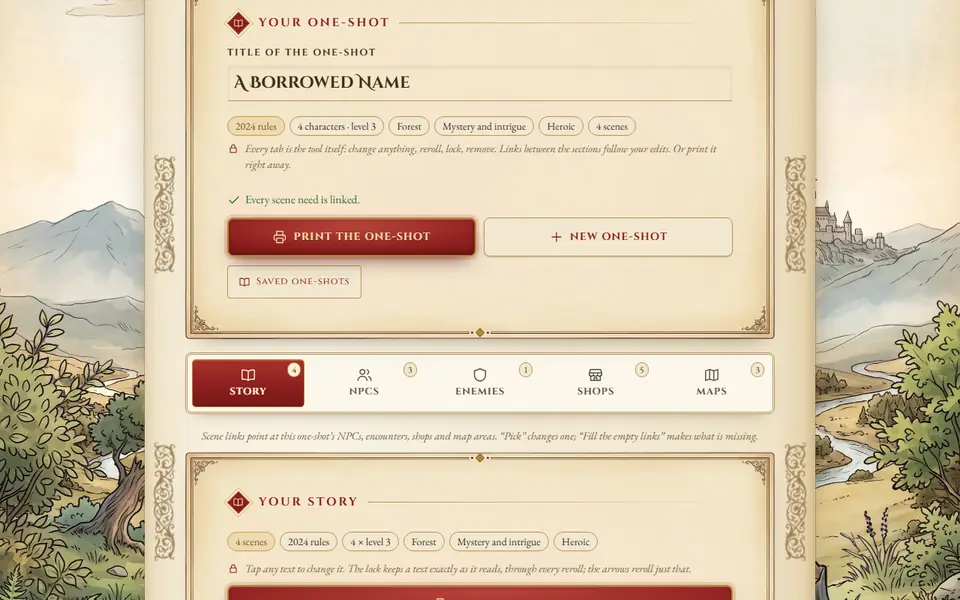
Press "Build the one-shot". It takes about a second and everything is saved in your browser: if you close the tab, the adventure is still there.
What came out: "A Borrowed Name"
This is the adventure the builder gave us, untouched:
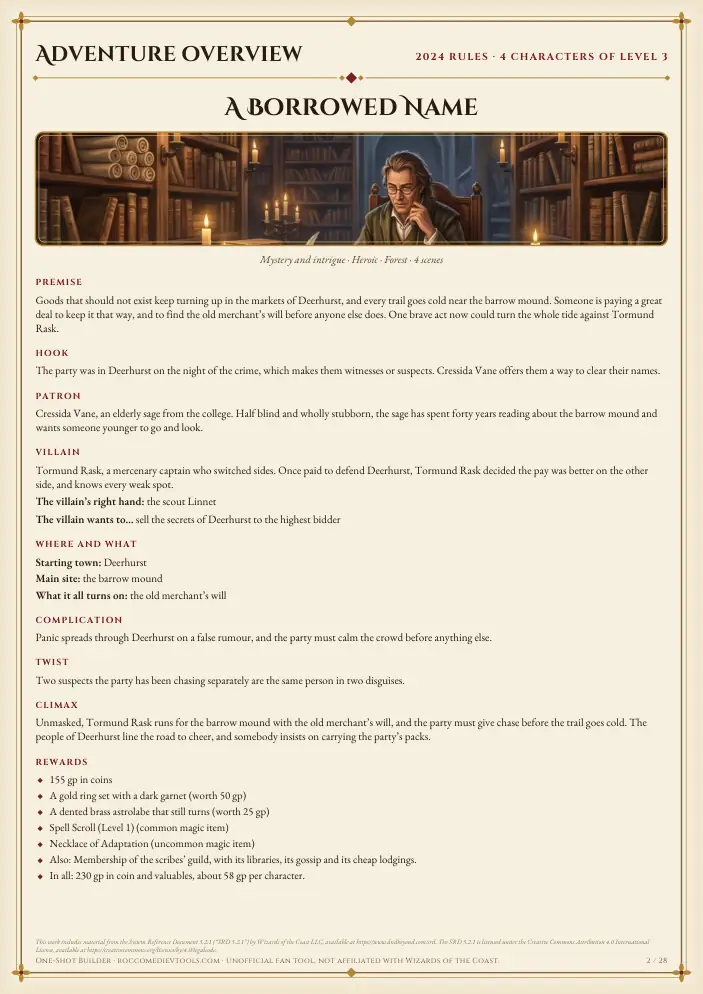
Premise. Goods that should not exist keep turning up in the markets of Deerhurst, and every trail goes cold near the barrow mound. Someone is paying a great deal to keep it that way, and to find the old merchant's will before anyone else does.
- Hook: the party was in town on the night of the crime, which makes them witnesses or suspects. The patron, Cressida Vane, an elderly sage, offers them a way to clear their names.
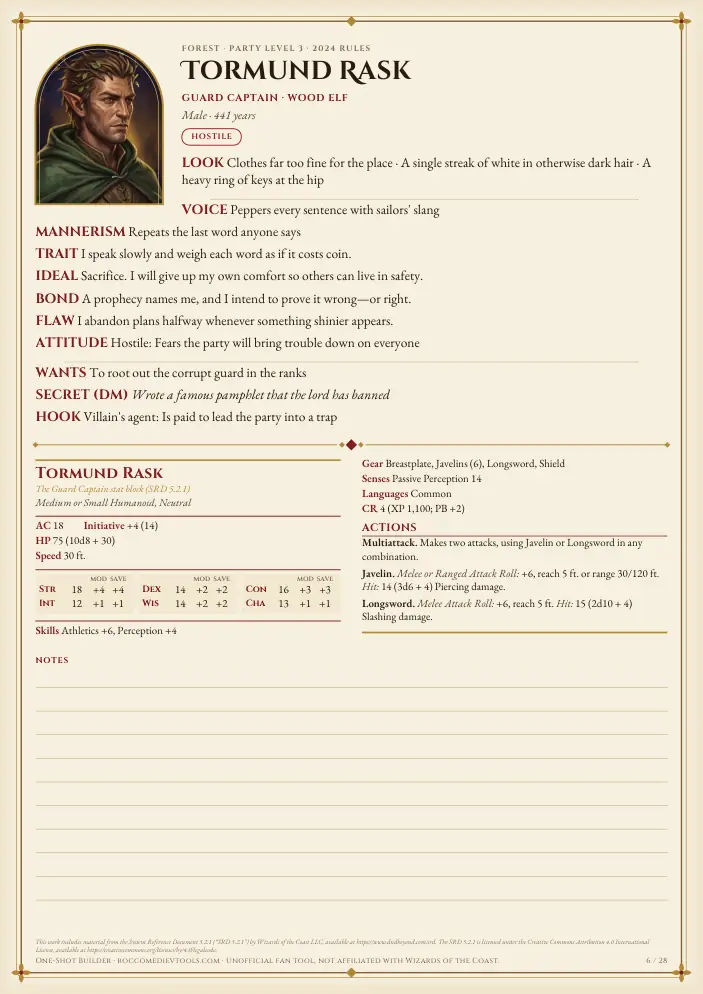
- Villain: Tormund Rask, a mercenary captain who switched sides, with his right hand, the scout Linnet. He wants to sell the secrets of the town to the highest bidder.
- Complication: a false rumour spreads panic and the party has to calm the crowd.
- Twist: two suspects the party has been chasing separately are the same person in two disguises.
- Climax: unmasked, Tormund runs for the barrow mound with the will and the party has to give chase.
- Rewards: 155 gp, a garnet ring (50 gp), a dented astrolabe (25 gp), a level 1 spell scroll, a necklace of adaptation and membership of the scribes' guild: about 58 gp per character.
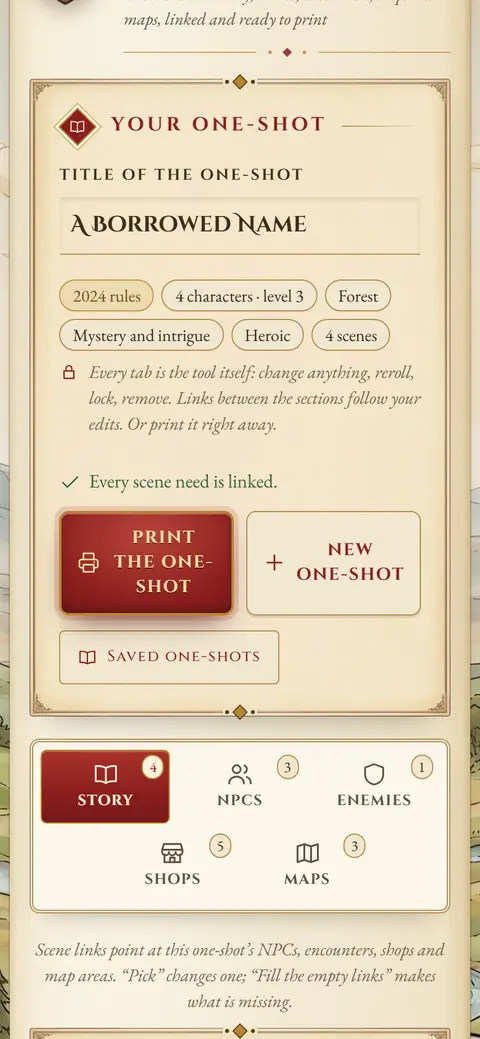
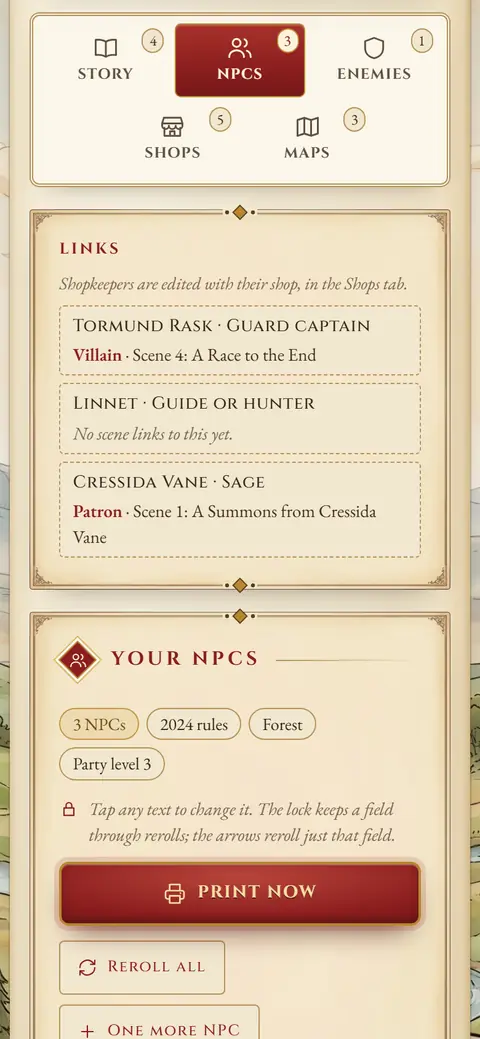
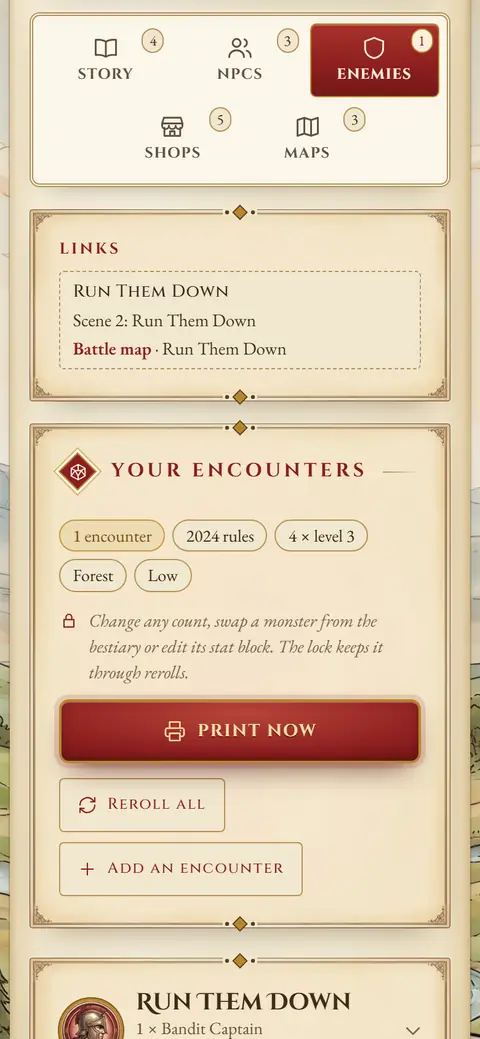
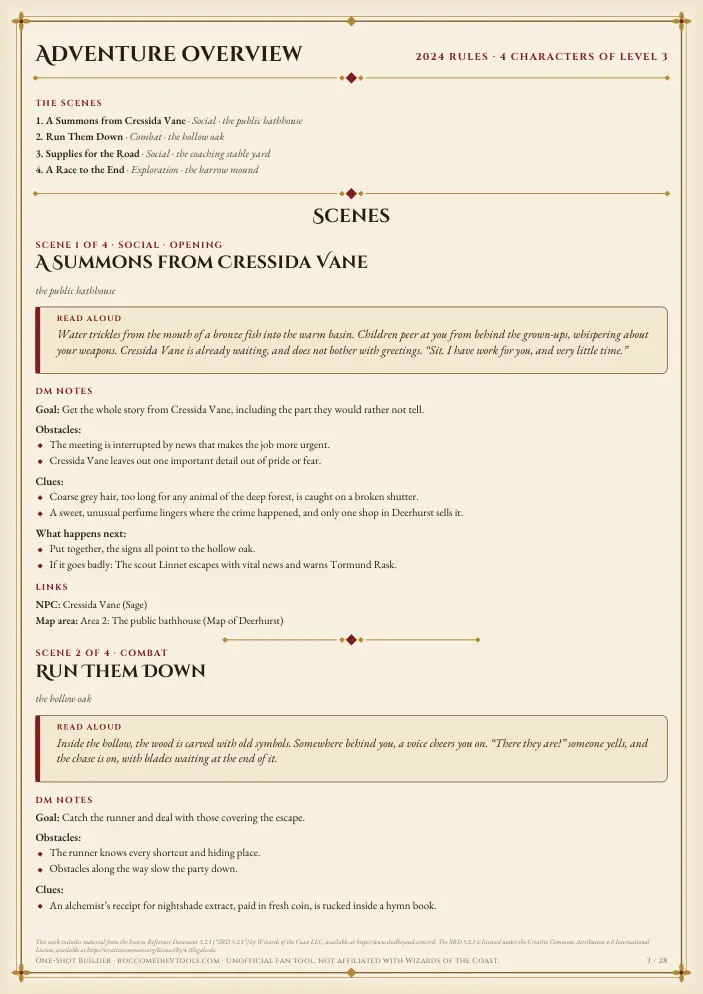
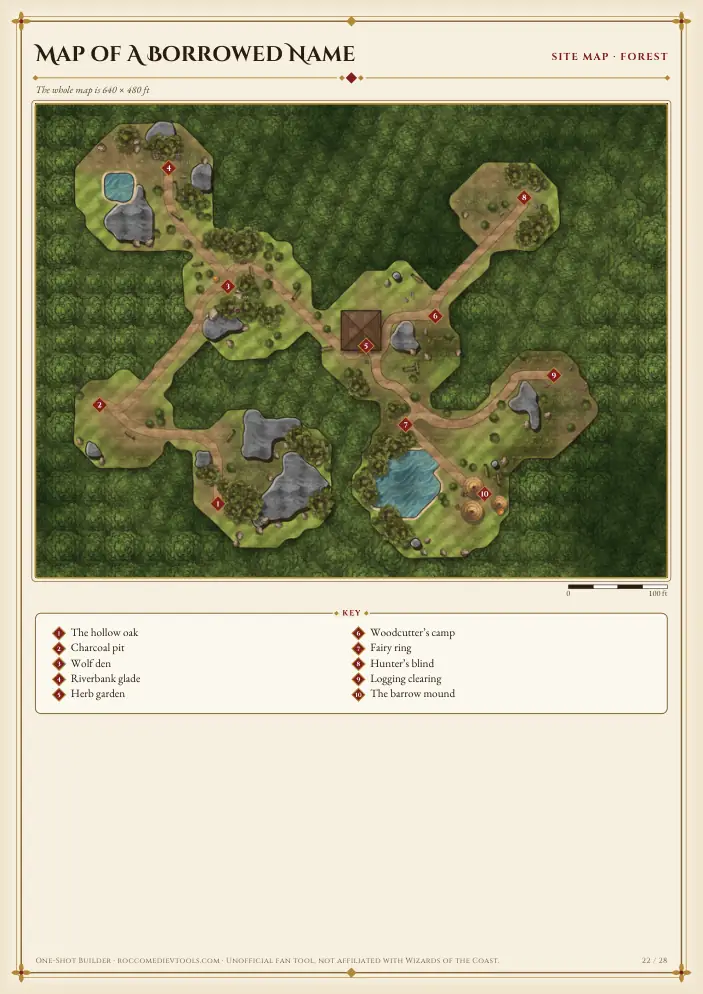
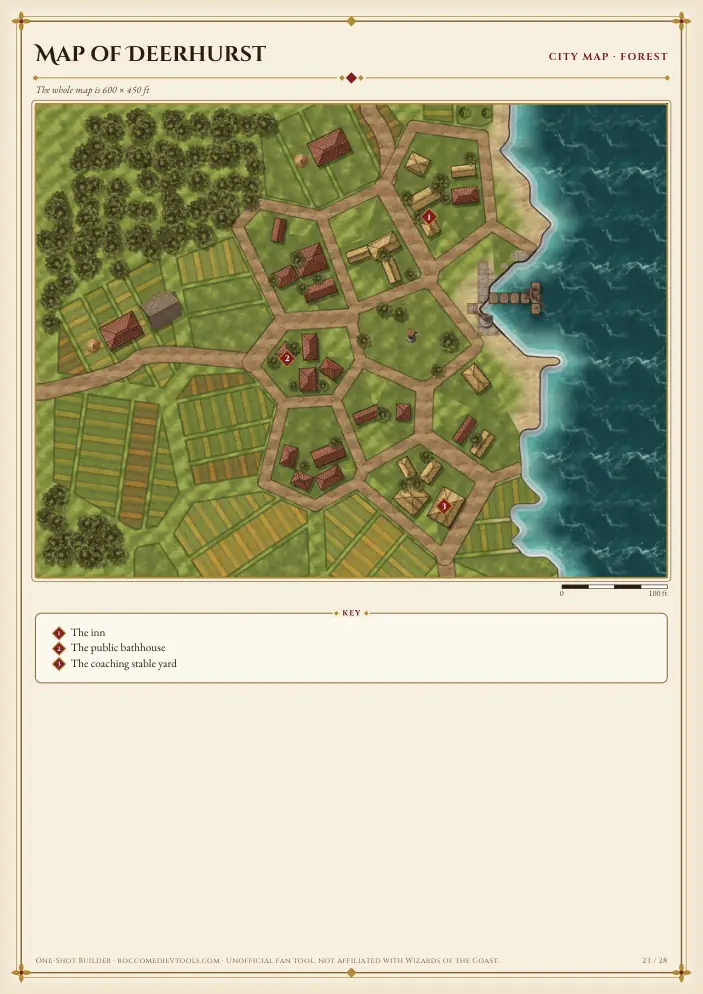
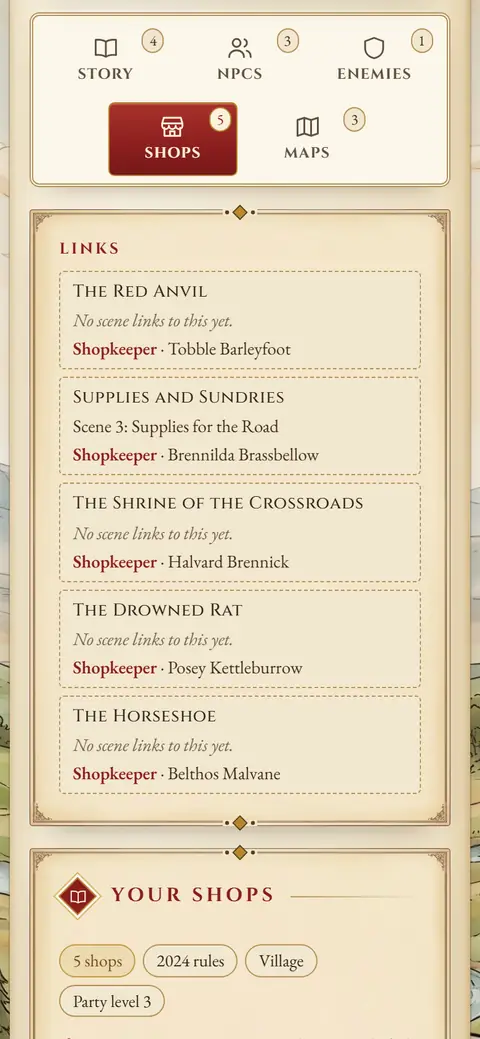
Four scenes: "A Summons from Cressida Vane" (social, at the public bathhouse), "Run Them Down" (combat, at the hollow oak), "Supplies for the Road" (social, in the coaching stable yard) and "A Race to the End" (exploration and climax, at the barrow mound). The builder also made 3 NPCs, 1 encounter, 5 shops with their shopkeepers and 3 maps: the forest with 10 numbered areas, the town and a battle map for the fight.
Minutes 5 to 20: read and decide
Read the overview and the scenes once, straight through (five minutes). Then make these four decisions, which are what turns a generated text into your adventure. Everything can be changed by tapping the text in its tab.
1. Who is who in the twist
The twist says two suspects are the same person in disguise, but not who. Decide now: we chose that Linnet, the scout, is also the "very polite stranger" asking about the will in scene 3. That way the twist is discovered in play and never needs explaining.
2. What each clue means
Clues come from tables and some are red herrings without an owner. In scene 1 there is a coarse grey hair "too long for any animal of the deep forest" and a perfume only one shop sells. Give each a meaning: the hair is from the wolf-skin cloak Linnet wears as a disguise; Tormund bought the perfume to pass as a merchant. A clue that leads nowhere frustrates; one that clicks in the third scene is what the players will remember.
3. What doesn't fit
NPC sheets are generated separately from the story, so they sometimes contradict it. Tormund's says he "wants to root out the corrupt guard in the ranks", odd for a turncoat. Rewrite it in a second: "wants to get paid and vanish before winter". The same goes for attitude and secret: keep what helps and change what doesn't.
4. Is there a final fight?
The climax is a chase, not a battle. If your group expects a fight, add one: in the Enemies tab, make an encounter with the guard captain (Tormund, CR 4, 1,100 XP) and the scout (Linnet, CR 1/2, 100 XP). That is 1,200 XP, between Moderate (900) and High (1,600) difficulty for four level 3 characters under the 2024 rules: a demanding but fair finale. Link it to scene 4 with "Link" and it appears in the PDF.
If you have a minute to spare, add one personal hook per player: the cleric knew the old merchant, the rogue owes Tormund money. No need to write it down; just say it when you start.
Minutes 20 to 30: print and set up the table
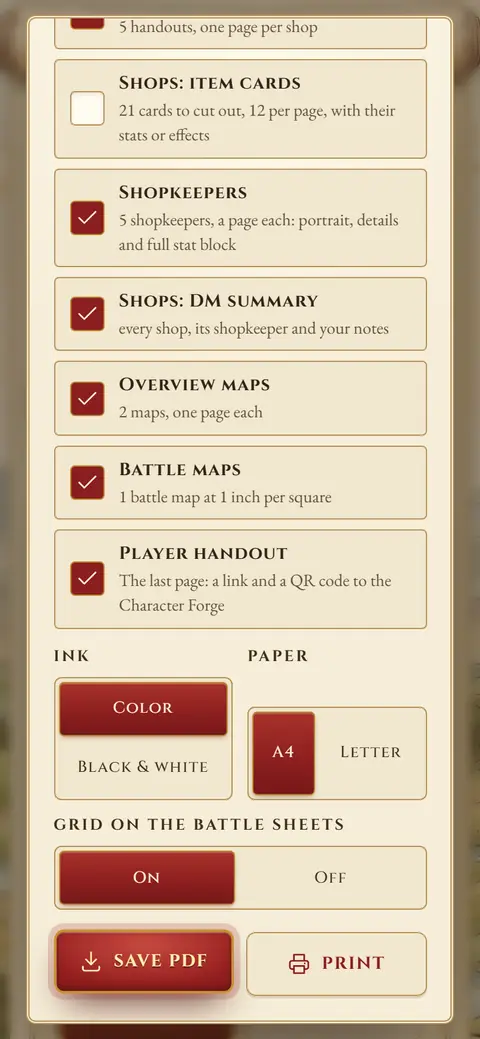
"Print the one-shot" opens a window with a checkbox per section. This adventure comes to 28 A4 pages; you don't need them all:
- For you, always: the cover and contents, the adventure overview, the scenes, the NPC sheets (one per NPC, with its full stat block) and the encounters with the creature sheets.
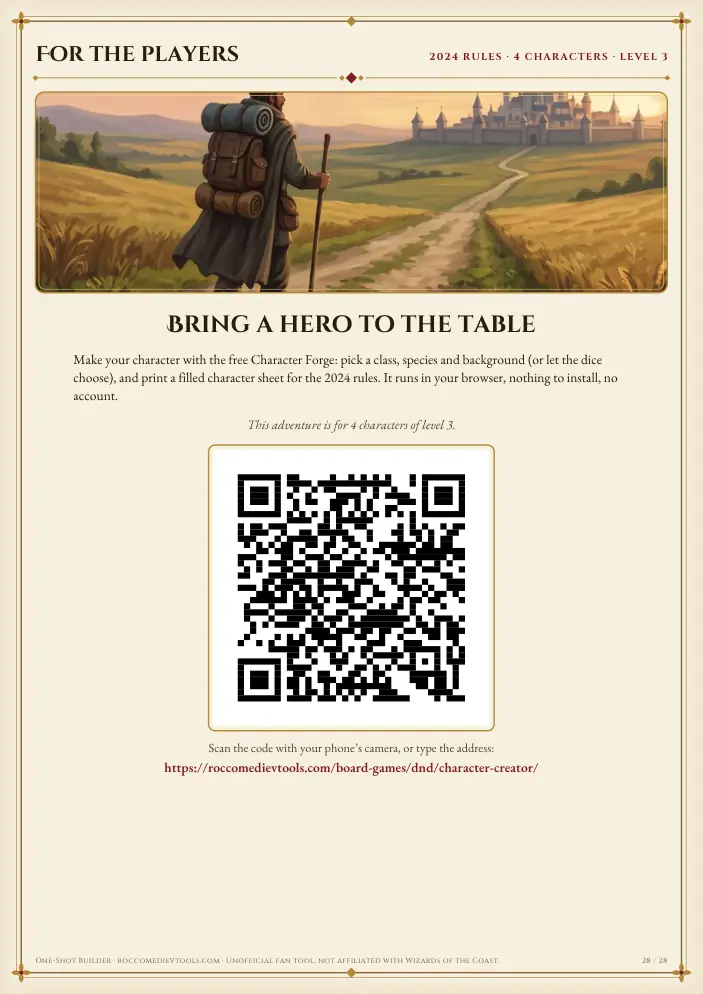
- For the table: the shop menus (you can hand them to the players), the overview maps and the player handout, which has a QR code to the Character Forge in case someone turns up without a character.
- If you play with miniatures: the battle map, at one inch per square, on four sheets that butt together edge to edge.
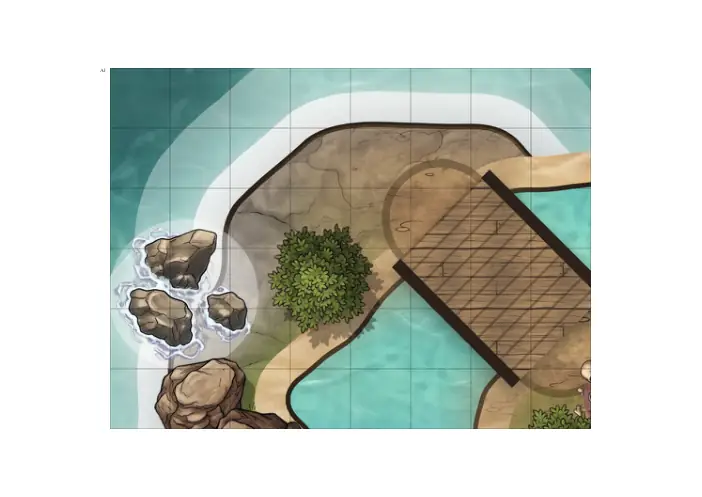
In black and white the PDF uses line-art pictures, which use little ink. If you have no printer, the PDF on a phone or tablet works just as well: the contents page has page numbers.
How to run each scene
A three-to-four-hour session gives about 40 minutes per scene, plus character introductions and a break. Keep a clock in sight: it is your best pacing tool.
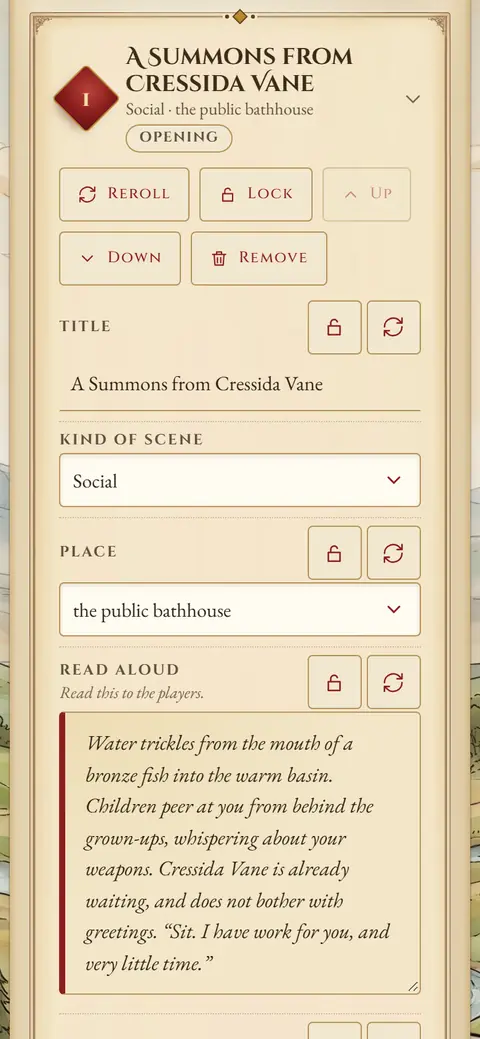
Scene 1: A Summons from Cressida Vane (social, about 40 minutes)
Read the box and let the players ask. Cressida has a goal ("get the whole story, including the part they would rather not tell") and two obstacles: an interruption with bad news and a detail she hides out of pride. Use the interruption as a clock: if the talk drags, the messenger arrives. The two clues are not found with rolls; they are found by looking. If someone wants more, ask for a Wisdom (Perception) or Intelligence (Investigation) check at DC 10 for an extra detail, never for the main clue.
The complication fits here too: as they leave the bathhouse, the false rumour is already running round the square. Two minutes of a frightened crowd let each character show who they are.
Scene 2: Run Them Down (combat, 30 to 45 minutes)
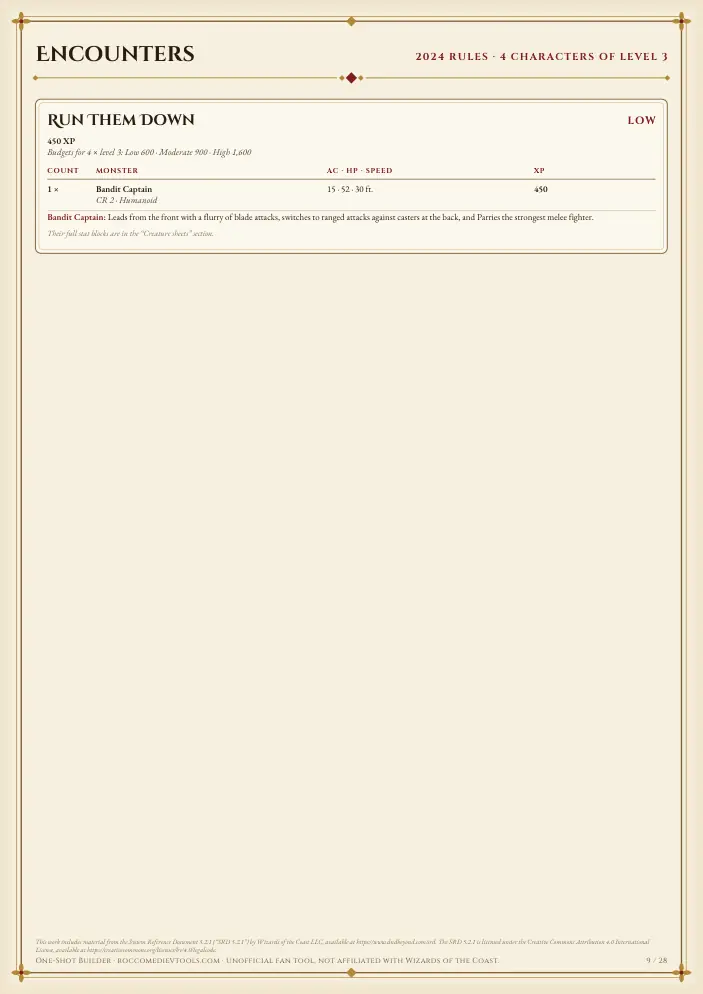
A bandit captain (AC 15, 52 HP, two attacks with scimitar or pistol and the Parry reaction, which adds 2 to its AC against one melee attack) flees through the trees by the hollow oak. For four level 3 characters it is a Low difficulty fight: it is there for the party to shine, not to drop someone. Have it shoot whoever casts spells and Parry the strongest fighter, as its tactics say. If after two rounds the party has it surrounded, let it try to surrender in exchange for information: that hands over the next clue without a search.
Scene 3: Supplies for the Road (social, about 30 minutes)
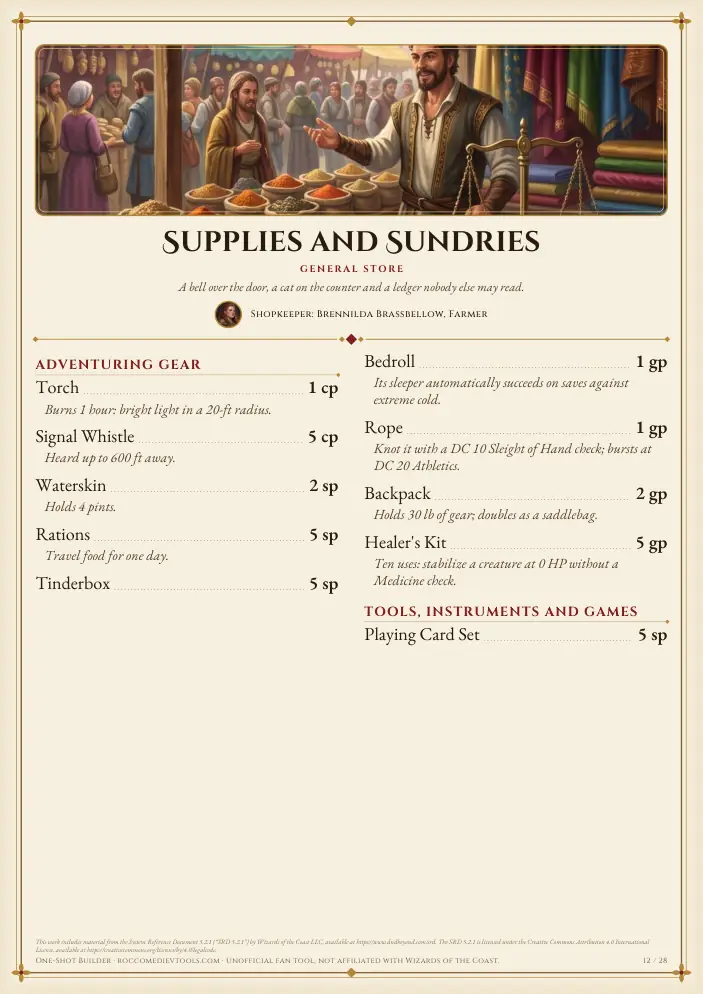
Brennilda Brassbellow's shop, Supplies and Sundries, has doubled its prices because of the crisis. Give the players the printed price list and let them haggle; it is a breather scene. The important clue is with a stable hand: a stranger asked twice, very politely, where the will would be. If you decided that was Linnet in disguise, this is the moment for them to suspect it.
Scene 4: A Race to the End (climax, 40 to 60 minutes)
Turn the chase into three obstacles, one per round: the mercenaries cutting them off (a Strength or Dexterity check at DC 12 to push through, or a short fight), the gap to jump (Strength (Athletics) at DC 12; whoever fails arrives late, they don't die) and the darkness of the barrow (Wisdom (Survival) at DC 15 not to lose the trail). Each success brings the party closer; two failures in a row and Tormund gets ahead and there has to be a fight in the final chamber. That is the place for the encounter you added, on area 10 of the map.
End with the scene the adventure itself suggests: the town lines the road to cheer and somebody insists on carrying the packs. Hand out the rewards right there.
When the players leave the script
They will, and it is a good sign. These are the answers that work with a generated adventure:
- Move the clue, not the players. If they decide to investigate the smithy instead of the oak, the alchemist's receipt is in the smithy. The clues are yours: put them where the party goes.
- Use the NPC sheets to improvise. Every NPC and shopkeeper has a want, a secret and a hook. If the players question someone you didn't plan for, read those three lines and you know what they say and what they hide. The blacksmith, for example, "overheard a plan and wants it to reach the right ears".
- A new NPC in ten seconds. In the NPCs tab, "One more NPC" makes a complete one with its stat block; or open the NPC Maker in another tab.
- A fight that wasn't there. If they attack the wrong person, Enemies & Encounters gives you a balanced group for the biome and difficulty you pick, with tactics.
- A place that wasn't there. Take an unused area of the forest map (the wolf den, the hunter's blind) and name it in the Maps tab; the Map Maker draws a new one if needed.
- The villain doesn't wait. If the party dawdles, tell them what Tormund does in the meantime: a second theft, a witness who vanishes. It is the gentlest way to steer the story back.
- They attack the patron or side with the villain. Let it happen and play out the consequences. A one-shot doesn't have to reach the written ending; it has to finish on a good scene.
Anything you change or add with the other tools goes into the same adventure with "Add to one-shot", and its links update in the scenes and in the PDF.
Printable checklist
Before the game (30 minutes)
- Generate the adventure with the real number and level of the players.
- Read the overview and the scenes straight through.
- Decide who is who in the twist.
- Give every clue a meaning (or cut it).
- Fix whatever doesn't fit on the NPC sheets.
- Decide whether there is a final fight and add it in Enemies.
- Think of a personal hook for each player.
- Print: overview, scenes, NPCs, encounters, shops, maps and the player handout.
At the table
- Clock in sight: about 40 minutes per scene.
- Read each box aloud, then stop talking: let them talk.
- Checks only when failing is interesting; DC 10 easy, 15 medium, 20 hard.
- If they get stuck, the villain acts.
- Clues go where the party goes.
- End on a scene and hand out the rewards.
Print this page as it is: the header, menu and footer stay off the paper. And if the players arrive without characters, the guide Your first character in 10 minutes gets them playing before the coffee goes cold.